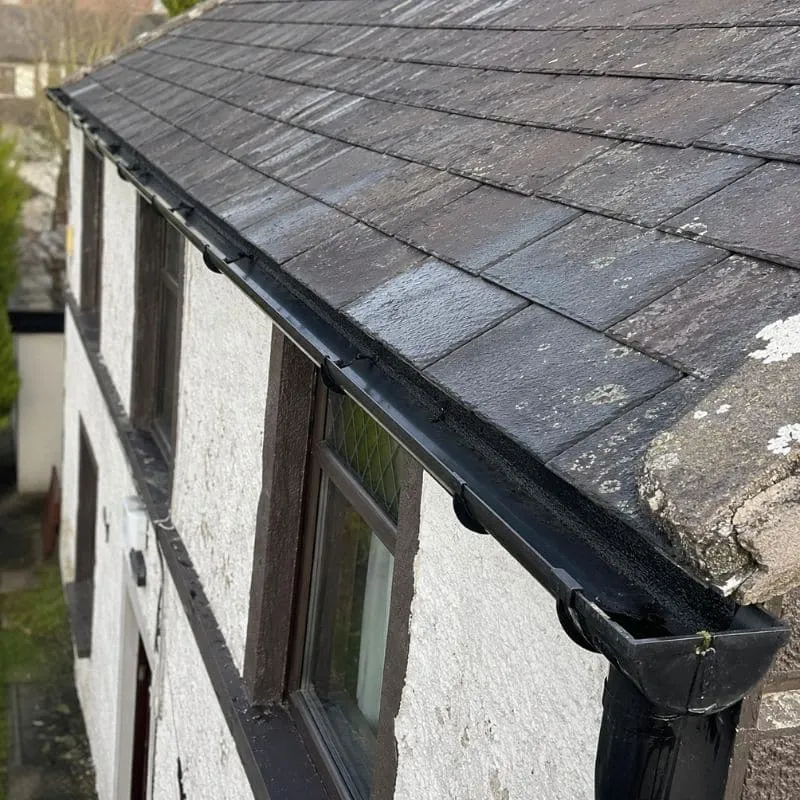
Fascia and soffit replacement costs in Cork depend primarily on the length of the roofline, how many sides of the property require work, access and whether deterioration is discovered behind the existing boards. As a general guide, replacing the front and rear fascia and soffits on a standard semi-detached home typically costs €1,000–€1,600, while a detached property can cost approximately €2,000–€3,500.
How Much Does Fascia & Soffit Replacement Cost in Cork?
A front-only fascia and soffit replacement on a standard semi-detached property typically costs €600–€900, while front and rear replacement costs approximately €1,000–€1,600. A standard detached home requiring all elevations typically costs €2,000–€3,500. Published prices are plus VAT and exclude scaffolding.
These figures are intended as a pricing guide rather than a fixed quotation. Roofline length, property height, access, materials, guttering and the condition of the supporting timber can all affect the final cost.
Typical Fascia & Soffit Replacement Prices in Cork
The table below provides typical costs for common fascia and soffit projects, from replacing one damaged section to renewing the complete roofline of a detached property.
| Work / property | Typical Scope | Typical Price |
|---|---|---|
| Semi-Detached – Front Only | Fascia and soffit replacement to the front elevation of a standard semi-detached property. | €600–€900 |
| Semi-Detached – Front & Rear | Replacement of fascia and soffits along both main elevations. | €1,000–€1,600 |
| Semi-Detached + New Gutters | New fascia, soffits and uPVC guttering to the front and rear elevations. | €1,400–€2,200 |
| Terraced House | Fascia and soffit replacement to a standard terraced property. | €800–€1,400 |
| Terraced House + Gutters | Replacement fascia, soffits and guttering to a standard terraced property. | €1,200–€1,900 |
| Detached – All Elevations | Complete fascia and soffit replacement around a standard detached property. | €2,000–€3,500 |
| Detached + New Gutters | Complete fascia, soffit and gutter replacement to a standard detached property. | €2,800–€4,500 |
| Large / Complex Detached | Complete replacement where the property has a larger or more complicated roofline. | €3,500–€6,000+ |
| Local Fascia Repair | Replacement of a damaged fascia section up to approximately 3 metres. | €150–€300 |
| Local Soffit Repair | Replacement of an isolated damaged soffit section. | €120–€250 |
For an exact price based on your property, we can inspect the existing roofline and provide a free quotation for fascia and soffit repair or replacement throughout Cork.
What Are Fascia and Soffits?
Fascia and soffits form the finished edge between the roof and the external walls of a property. Although they are often discussed together, they perform different jobs.
The fascia runs horizontally along the roof edge. It creates a finished face at the ends of the roof structure and commonly provides the fixing surface for the gutter brackets.
The soffit covers the underside of the roof overhang between the fascia and the external wall. Depending on the roof design, it may also form part of the ventilation arrangement for the roof space.
Fascia
The vertical-facing board along the roof edge. Guttering is commonly fixed to the fascia, so it needs to provide a sound and secure fixing surface.
Soffit
The horizontal or angled board beneath the roof overhang. It closes and finishes the underside of the roof edge and can incorporate ventilation where required.
How Much Does Fascia & Soffit Replacement Cost on a Semi-Detached House?
For a standard semi-detached property, replacing the fascia and soffits on the front elevation typically costs €600–€900. Published prices are plus VAT and exclude scaffolding.
Replacing both the front and rear typically costs €1,000–€1,600. Published prices are plus VAT and exclude scaffolding.
If new uPVC guttering is installed at the same time, a typical combined price for the front and rear elevations is approximately €1,400–€2,200. Published prices are plus VAT and exclude scaffolding.
The final figure depends on the actual roofline length, property height, access and whether deterioration is discovered behind the existing fascia once it is removed.
How Much Does Fascia & Soffit Replacement Cost on a Detached House?
A standard detached property requiring fascia and soffit replacement across all elevations typically costs approximately €2,000–€3,500. Published prices are plus VAT and exclude scaffolding.
Where the gutters are also being completely replaced, the combined project typically costs approximately €2,800–€4,500. Published prices are plus VAT and exclude scaffolding.
Larger detached homes or properties with complicated rooflines can cost approximately €3,500–€6,000+. Published prices are plus VAT and exclude scaffolding.
Dormers, projecting roof sections, multiple elevations and additional corners all increase the amount of cutting, joining and finishing required compared with a simple uninterrupted roofline.
How Much Does Fascia & Soffit Replacement Cost on a Terraced House?
A standard terraced property typically costs approximately €800–€1,400 for fascia and soffit replacement. Published prices are plus VAT and exclude scaffolding.
Where new guttering is included, the typical combined cost increases to approximately €1,200–€1,900. Published prices are plus VAT and exclude scaffolding.
Access can have a significant influence on terraced properties. Restricted side or rear access, adjoining properties and the height of the roofline can all affect how the work is carried out.
Can Just One Section of Fascia or Soffit Be Replaced?
Yes. Complete replacement is not necessary simply because one localised section has become damaged.
A fascia section of up to approximately three metres can typically cost €150–€300 to replace, while an isolated soffit section typically costs €120–€250. Published prices are plus VAT and exclude scaffolding.
Localised repair makes most sense where the surrounding roofline remains sound. If deterioration is appearing along several sections, a complete replacement may provide better value than carrying out repeated individual repairs.
Section Repair
Suitable where one fascia or soffit section has failed but the remainder of the roofline remains in serviceable condition.
Typically €120–€300
Full Replacement
Worth considering where deterioration affects multiple sections or the existing roofline is generally approaching the point where repeated repairs offer poor value.
Priced according to property and elevations
What Is the Difference Between Capping and Full Replacement?
This is an important distinction when comparing fascia and soffit quotations.
Capping generally involves fitting a new covering over existing fascia rather than completely removing the original material.
Full replacement involves removing the existing boards so the condition of the materials behind them can be assessed before the new fascia and soffit system is installed.
Capping and replacement are therefore not equivalent scopes of work, even if the finished roofline can initially appear similar from ground level.
If one fascia quotation is substantially cheaper than another, check whether both involve complete removal and replacement of the existing boards or whether one is quoting for an over-cap system.
Is Capping Existing Timber Fascia a Good Idea?
It depends on the condition of the material underneath.
Covering an existing board does not repair deterioration behind it. If timber fascia is already rotten, soft or otherwise defective, that problem needs to be addressed before relying on it as part of the finished roofline.
Where existing material is suitable for an over-cap system, the specification should make that clear. Where deterioration is present, full removal provides the opportunity to inspect the underlying roof edge and deal with defective material before new fascia is installed.
What Happens if the Timber Behind the Fascia Is Rotten?
Removing existing fascia can expose deterioration that was not fully visible beforehand.
The ends of roof timbers sit behind the fascia, and if they have been exposed to prolonged moisture they may require repair before the new roofline can be securely installed.
Where individual rafter-tail repairs are necessary, a typical additional allowance is approximately €80–€150 per rafter. Published prices are plus VAT and exclude scaffolding.
This is one of the reasons a fascia quotation should explain how any previously hidden timber deterioration will be handled if it is discovered once the existing boards are removed.
A neat new uPVC roofline is only part of the job. Any defective supporting material discovered during removal should be dealt with before it is concealed again.
What Affects Fascia & Soffit Replacement Cost?
The number of boards being replaced is important, but several other factors determine the actual scope of work.
Roofline Length
Longer properties require more fascia, soffit, fixings and labour, making the total length of roofline one of the main pricing factors.
Number of Elevations
Replacing only the front elevation is a substantially smaller job than completing the front, rear and sides of a detached property.
Property Height
Higher rooflines can require different access arrangements and additional setup compared with lower, easily accessible sections.
Roofline Complexity
Dormers, bays, projecting roofs, corners and multiple sections require additional cutting, joining and finishing.
Condition Behind the Fascia
Deteriorated supporting timber may only become fully visible after the existing fascia has been removed.
Guttering
Removing fascia normally involves dealing with the attached guttering, so whether existing gutters are being reused or replaced affects the scope.
Should Gutters Be Replaced at the Same Time?
Not automatically. If the existing guttering remains in good condition and is suitable for reuse, there may be no need to replace it simply because new fascia and soffits are being installed.
However, the gutters normally need to be removed or disturbed to access the fascia behind them. If the existing gutter system is already brittle, leaking or damaged, this can be a sensible opportunity to replace both systems together.
Typical combined prices are approximately €1,400–€2,200 for fascia, soffits and guttering to the front and rear of a standard semi-detached property, and approximately €2,800–€4,500 for a standard detached home. Published prices are plus VAT and exclude scaffolding.
For a full breakdown of gutter costs, see our gutter repair and replacement cost guide for Cork.
Why Does Fascia Condition Matter to Your Gutters?
Gutter brackets are commonly fixed directly to the fascia. That means even perfectly good guttering cannot remain securely positioned if the material supporting its brackets has significantly deteriorated.
Loose brackets can allow gutter sections to move or sag, affecting the fall towards the downpipe and potentially causing rainwater to overflow.
If your gutters repeatedly pull away from the roofline, checking the fascia behind them is therefore just as important as checking the gutter itself.
Do Soffits Need Ventilation?
Roof-space ventilation needs to be considered when replacing soffits because some roof designs use vents within the soffit as part of their ventilation arrangement.
The correct solution depends on the construction of the individual roof. Existing ventilation should not simply be covered or removed without considering how the roof space is intended to ventilate.
Depending on the property, the replacement may use ventilated soffit boards or another suitable ventilation detail.
What Are the Signs Fascia or Soffits Need Attention?
Problems can be cosmetic at first, but deterioration may also affect how the roof edge and gutter system perform.
Signs worth investigating include:
Peeling or badly deteriorated timber fascia
Soft or visibly rotten sections
Cracked or broken soffit boards
Gutters pulling away from the roofline
Loose gutter brackets
Visible gaps along the roof edge
Sections of fascia beginning to distort or detach
Water staining around the roofline
Recurring gutter alignment problems
Visible deterioration behind damaged sections
What Colours Are Available for uPVC Fascia & Soffits?
uPVC roofline products are available in a variety of finishes, allowing fascia and soffits to coordinate with windows, doors, guttering and the wider exterior of the property.
Common options include white as well as darker and wood-effect finishes. Exact availability depends on the particular product system selected.
Non-standard finishes may cost more than standard white uPVC, so the selected colour and profile should be confirmed as part of the quotation.
Do You Have to Replace Fascia and Soffits Together?
No. If only one component is defective and the other remains in good condition, it may be possible to replace only the damaged part.
However, fascia and soffits meet along the same roof edge and are often accessed as part of the same work. Where both are ageing or deteriorated, replacing them together can provide a more complete roofline renewal.
The decision should be based on their actual condition rather than automatically replacing sound material.
What Should a Fascia & Soffit Quote Include?
When comparing quotations, make sure each contractor is pricing the same scope. A quote for capping existing fascia is not directly comparable with a quote for removing and completely replacing it.
A clear quotation should specify:
Which elevations are being replaced
Whether existing fascia is being removed or capped
The fascia and soffit material being installed
The selected colour and profile
How roof-space ventilation will be maintained
Whether existing gutters are being reused
Any new guttering included
How hidden timber deterioration will be handled
Any access or scaffolding requirements
Removal and disposal of old materials
Getting an Accurate Fascia & Soffit Replacement Quote
Property type provides a useful starting point, but the most accurate way to price fascia and soffit replacement is to assess the actual roofline.
The length of each elevation, height, access, guttering, roofline complexity and visible condition of the existing materials can then be considered before the work is specified.
Any potential for concealed timber deterioration should also be discussed so you understand how additional repairs would be handled if they become visible during removal.
Fascia & Soffit Replacement Across Cork
We provide fascia, soffit and roofline work throughout Cork City and County, including Douglas, Ballincollig, Carrigaline, Midleton, Cobh, Mallow, Bandon, Macroom and surrounding areas.
Whether you need one damaged section repaired or want to replace the complete fascia, soffit and gutter system around your property, we can assess the roofline and provide a quotation based on the work required.
You can view all areas we cover across Cork or contact the team to arrange a free quotation.